Most older flats in Alicante have had their consumer unit changed at some point. Far fewer have had their cables changed. That is how a home ends up with a modern board, a sensitive RCD and wiring underneath it that was laid for a household with a radio, a fridge and a few lights.
This guide is about the wiring itself: how to tell when it is the cable, not the board, that has reached the end, and what replacing it actually involves. If you are still deciding between a board swap and a rewire, our guide to replacing a consumer unit compares the three jobs side by side.
When is it the wiring and not the board?
The board is easy to judge by eye. The cable is not, because almost all of it is hidden in the walls. But it leaves clues.
The RCD keeps tripping and nothing is plugged in. A new, sensitive RCD on old cable often trips in damp weather or after a wet night, with nothing switched on. That is current leaking through tired insulation, and it is the most common way a board upgrade reveals a cable problem.
Insulation that crumbles or has gone hard. When a socket or switch is taken off, the cable behind it should be flexible. Insulation that cracks when it is bent, fabric-covered cable, or cable that has gone brittle and yellow near light fittings has had its life.
No earth conductor in the box. If the green and yellow wire is missing behind the sockets, the earth pin connects to nothing. In many older buildings the sockets were swapped for earthed ones without an earth ever being run.
One circuit doing everything. Lights and sockets for half the flat on one breaker, or the kitchen sharing a circuit with the bedrooms, is a design that predates the current rules. Under ITC-BT-25 a home has separate circuits for lighting, general sockets, the cooker and oven, the washing machine and dishwasher, and the kitchen and bathroom sockets.
Joints in the wrong places. Connections made with tape, junction boxes without covers, cable run along the surface with staples rather than in conduit. These usually mean the installation has been extended many times, by many hands.
Warm sockets, flickering lights, scorch marks. These are faults first and age second. Our guide to common electrical faults helps you tell an urgent one from one that can wait.
None of these on its own proves the property needs a rewire. A test does. Insulation resistance and the earth are measured before anyone decides the scope, because the measurement is what separates a partial job from a full one.
Partial or full rewire?
A partial rewire replaces some circuits and keeps the rest. It suits a flat where the cable mostly tests well but one area has outgrown it: a kitchen that now runs an induction hob, an oven and a dishwasher, a bathroom that has been redone, or a room that will take air conditioning and needs its own circuit.
A full rewire replaces the circuits throughout. It is the honest answer when the insulation tests poorly across the property, when there is no earth conductor in most of the boxes, or when the circuit layout would need replacing room by room anyway.
There is a middle case that is easy to miss: the cable tests well but the layout is wrong. Five circuits where you now need eight is not fixed by a better board. New circuits are added and the old ones are kept where they are still sound.
What tips the decision is usually not cost but timing. If the kitchen, the bathroom or the floors are being redone anyway, that is the cheapest moment the walls will ever be open, and the argument for doing the whole installation becomes much stronger.
New cable through old conduit, or chasing the walls?
This is the question that decides how much building work comes with the electrical work, and it depends on what is in the walls rather than on the age of the flat.
Where the cable runs through corrugated conduit that is intact and has room, the old cable is pulled out and the new one drawn in, and the walls are not opened. Where the conduit is crushed, blocked or absent, because the cable was plastered straight into the wall, new routes have to be made. That can mean chasing the walls and making good, or using surface trunking or a false ceiling where opening walls is not an option.
Most flats end up as a mix: some runs drawn through, some new. We check this before quoting, so the quote says which walls, if any, will be opened. Our page on consumer units and rewiring covers what the conduit test involves and how the work is phased if you are living in the property.
What to decide before the work starts
A rewire is the one chance to put the installation where you actually need it. A few decisions are much cheaper made now than later:
- Socket positions. Where the bed, the desk and the television will go, and how many sockets each needs. Every extension lead you plug in today is a socket in the wrong place.
- Air conditioning. Dedicated circuits for current or future units, ideally with the outdoor positions agreed.
- The kitchen. The cooker, the oven, the dishwasher and the washing machine each on the circuit the regulations give them.
- An EV charger. If there is any chance of one in a private garage, it is worth knowing the route now. Our guide to charging without raising your contracted power explains how a charger shares the supply.
- Bathrooms. The zones around a bath or shower restrict what can go where under ITC-BT-27, which matters if the bathroom is being redesigned.
A home that will run an induction hob, air conditioning in several rooms and an electric water heater is usually an elevated electrification installation under ITC-BT-25, with more circuits than the basic level. Designing to that from the start avoids a second visit.
The building’s side: the riser and the meter room
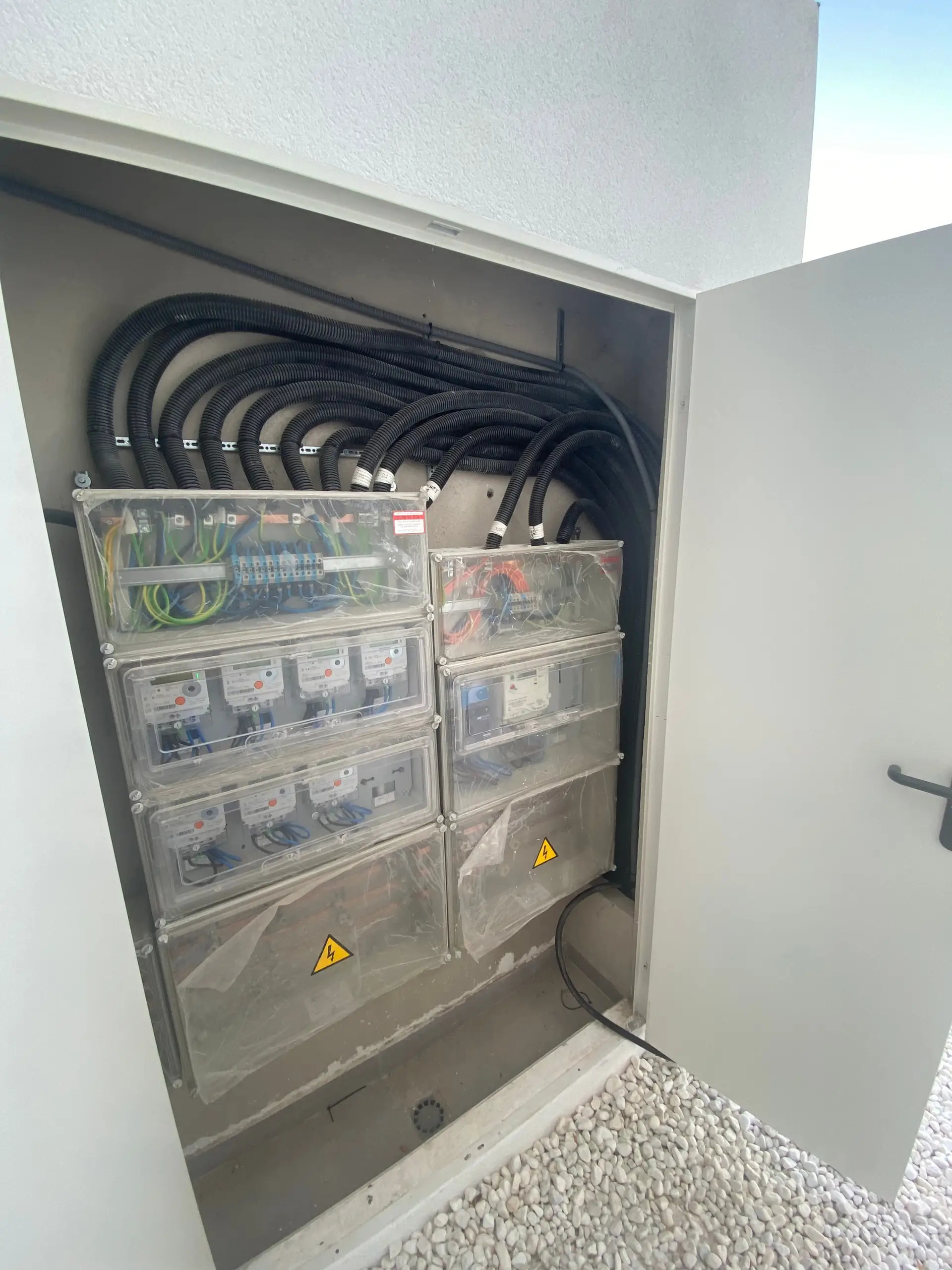
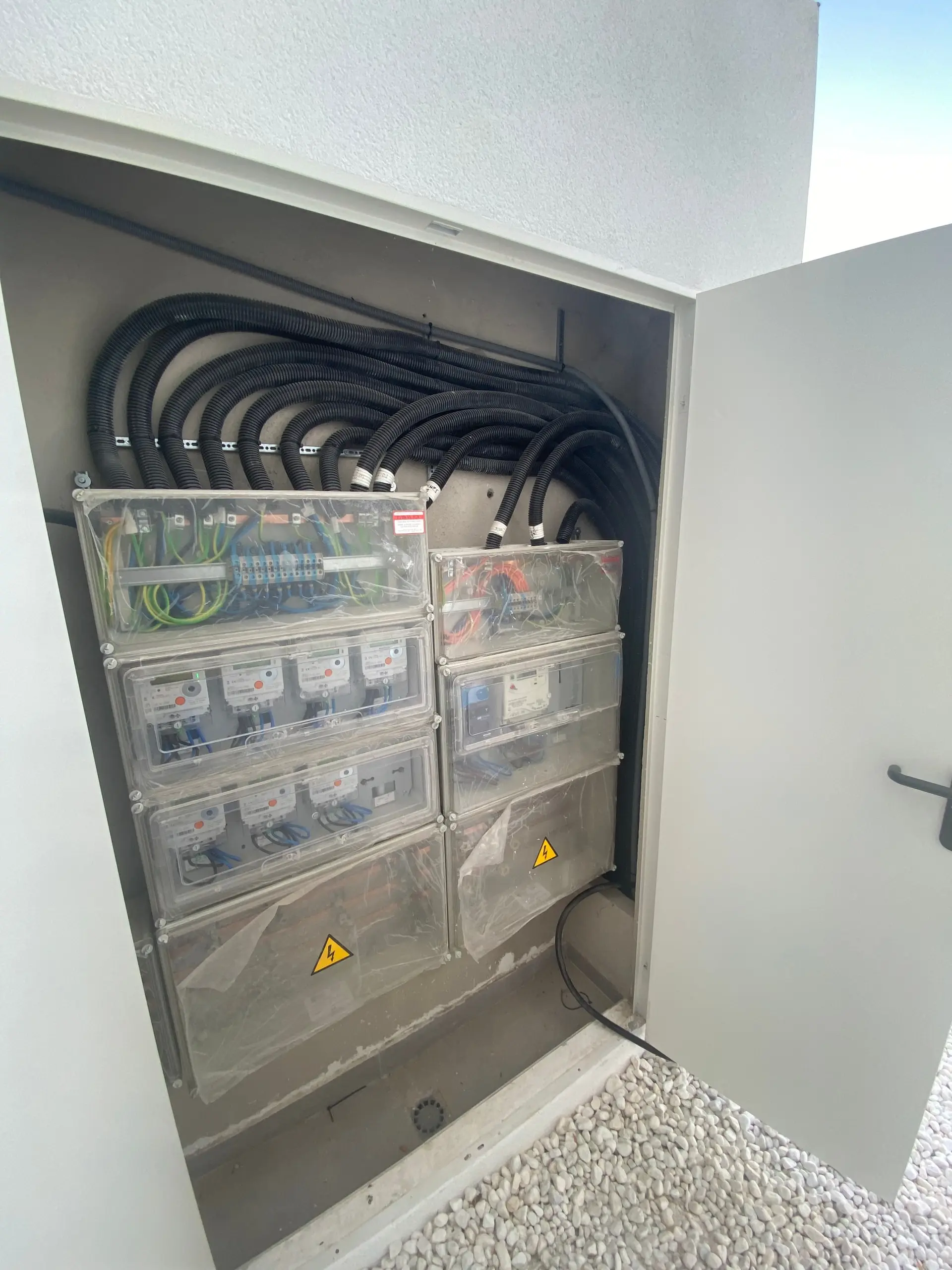
Everything after your meter is yours. The meter itself, the meter room and the cable that runs from the meter up to your flat, the derivación individual, sit in the communal parts of the building.
That cable matters more than people expect. It sets the ceiling on how much power the flat can take. In older buildings it is often sized for the household of the time, so a flat rewired for an elevated installation may need the derivación individual replaced before a power increase can be granted. That work runs through communal areas, so it is agreed with the building’s administrator first.
In older blocks in the centre of Alicante, the communal side is often where the timeline is decided, which is why we look at it at the first visit rather than at the end.
The certificate at the end
A full rewire is treated as a new installation, so it ends with a new electrical certificate (CIE) registered with the Generalitat. A partial rewire comes with the documentation for the work done, and it may also need a new certificate if it changes the installation substantially or comes with a power increase. We tell you which at the quote stage.
As with any certificate: we carry out the work and prepare the paperwork, and the certificate is issued and signed by the authorised installer we work with. Our guide on how to get an electrical certificate in Alicante explains how it is registered and handed to the supply company.
If you are buying an older flat and wondering whether it will need this, the electrical checks before buying guide shows what to look at before you sign.
How to get a rewire assessed
Send us a photo of the consumer unit with its door open, a photo of one of the older sockets or switches, and a line about what you are planning for the flat. Use the contact form or WhatsApp. Photos help us understand the job before the visit; the scope and the price come after we have tested the installation.