Most owners in a comunidad de propietarios who want a home charger start with the wrong question: will the community let me? The legal answer is simple and in your favour. The practical questions are the ones worth your time — where the power comes from, how the cable reaches your space, and how the job is done so the next neighbour does not have to start from zero.
Do you need the community’s permission?
No. If the charging point is for your own use and goes in your own parking space, you only need to notify the community in writing before you install it. This is set out in article 17.5 of the Ley de Propiedad Horizontal, and it is a right, not a favour the junta grants.
Two conditions come with it. The installation and the electricity it consumes are paid entirely by you, not by the community. And it applies to an individual parking space — a charger in a shared area, or one meant for several users, is a different conversation that does go to the community.
It is worth knowing this before the next meeting. Plenty of owners have been told at a junta that a vote is needed. It is not.
Where does the electricity come from?
This is the real decision, and there are three ways to do it.
From your own home’s supply. A new circuit leaves from your meter position in the building’s meter room and runs down to your space. The charger’s consumption appears on the electricity bill you already pay. This is often the simplest route when the meter room and the garage are close together.
A separate supply with its own meter. The charging point gets its own connection and its own contract. The consumption is still clearly yours, and it is independent of your home’s contracted power. It involves the distributor, so it takes more steps.
From the communal supply. The charger hangs off the garage lighting board and the community is supposed to recover the cost from you. This is the option we advise against. The community’s contracted power was never sized for cars, the sums are settled informally, and when the second and third chargers arrive nobody is sure who owes what.
Which of the first two suits you depends on your home’s contracted power, the distance, and what the meter room physically has space for. That is something we see by reading the supply, not something to decide over a message.
How does the cable get to your space?
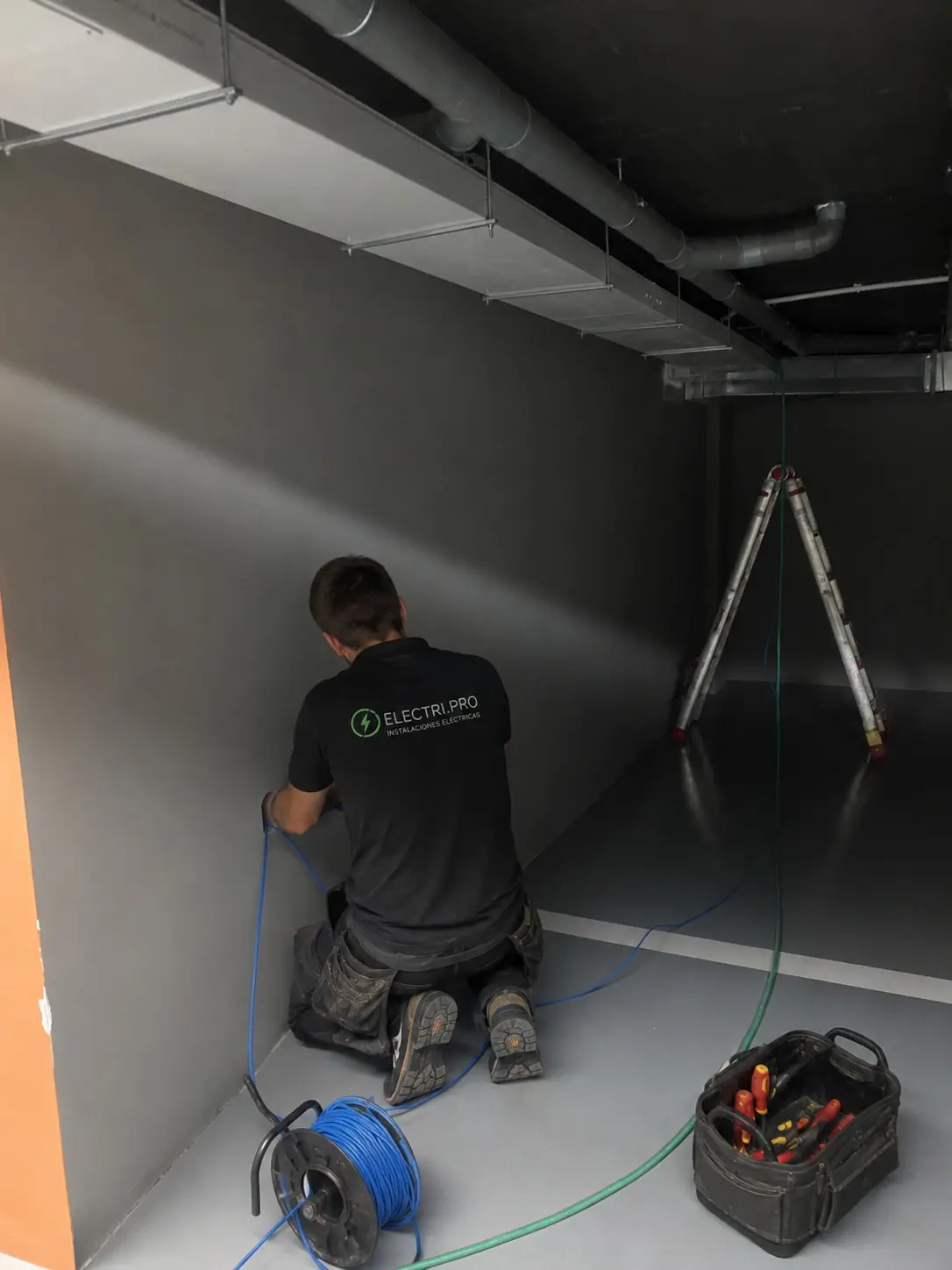
Along communal ceilings and walls, on proper containment, from the supply to your space.
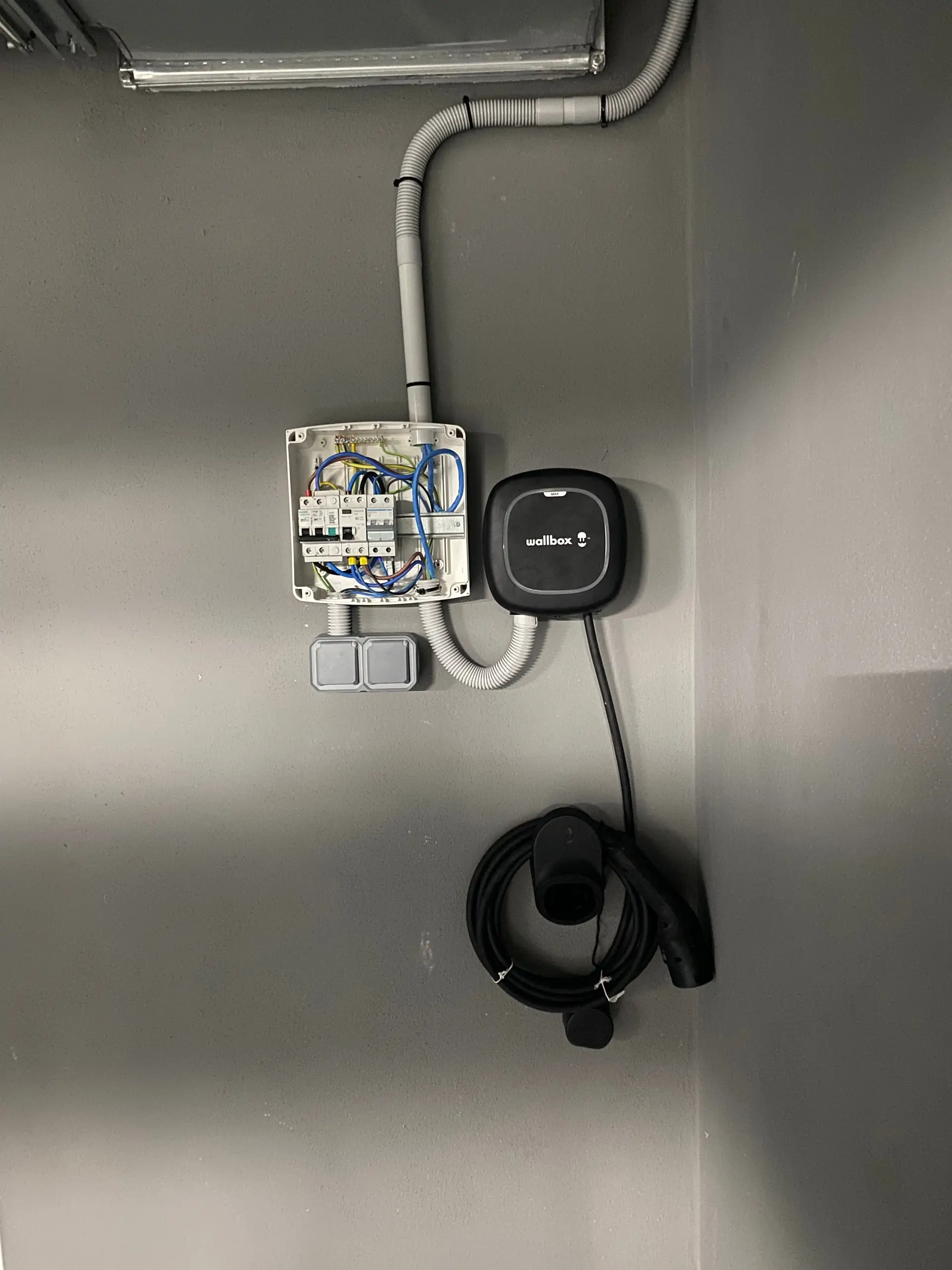
Containment means tray or conduit fixed to the structure, not cable clipped along a beam or laid loose above a false ceiling. In a garage it has to cope with vehicles, cleaning and the odd van roof, so it runs high, is fixed properly and is protected where it passes anything that could strike it.
The route has to be planned before anything is fixed. It crosses spaces you do not own, it may pass through fire-separating walls between the meter room and the garage, and it should not obstruct lighting, ventilation or anyone else’s space. Agreeing it up front is what stops a complaint afterwards.
Why should the route be extendable?
Because you are rarely the last owner in the garage to want a charger.
In most buildings, once one space has a charger, a second and third owner follow within a couple of years. If the first installation leaves a containment route sized only for one cable, every later owner has to fix another tray alongside it, and the ceiling ends up a mess of parallel runs.
We install so the route can take more. The tray is sized with room for further cables, and it runs along the natural spine of the garage rather than taking the shortest line to one space. It costs little extra at the time, and it is the detail administrators notice most.
What should you tell the administrator?
A short written notice, sent before the work starts, is all that is required. Make it useful rather than minimal:
- what you are installing and in which parking space;
- where the supply comes from — your own home’s meter or a new separate supply;
- the route the cable will take through communal areas;
- roughly when the work will happen and for how long.
Sending it to the administrator, with the president in copy, keeps it on record. If the administrator asks questions, answer them; cooperation costs nothing and the right to install does not depend on it. We are used to dealing with administrators and can describe the route in terms that answer their questions before they are asked.
What paperwork do you get?
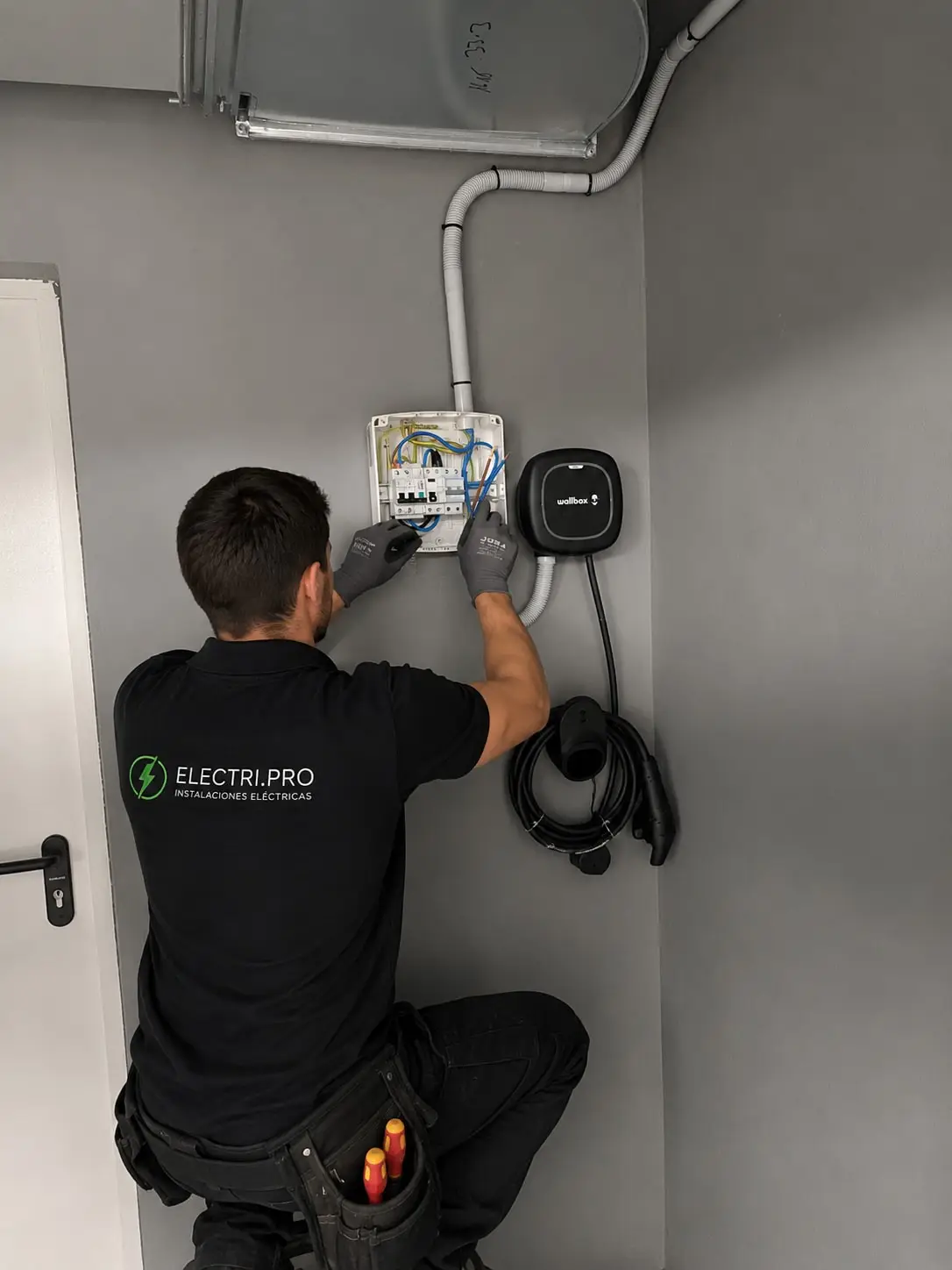
You get the invoice and the installation documentation for the circuit. That is what you give the community to close the notification, what a buyer’s lawyer will ask about if you sell, and what you need for any deduction you may be claiming.
Keep it with the notice you sent. Together they show the installation was notified correctly and done properly.
What makes a communal job more complicated?
Three things, and they are the reason nobody can quote a garage from a photograph.
Distance. Meter rooms are often on the ground floor or at the far end of the building, and your space may be two levels down. Runs of 30 or 40 metres are normal, and cable is sized for voltage drop over the whole length at full load, so a long run needs a heavier conductor. That is usually the largest line in the quote.
The path between the meter room and the garage. Separating walls, shafts that are already full, and floors that have to be crossed all add work that is invisible until someone walks the route.
Supply capacity. If the charger comes off your own home’s supply, it has to fit inside your contracted power alongside everything else in the flat. Dynamic load management usually solves that without raising your contracted power. If it does not, a separate supply may be the better answer.
The charger itself is the same one you would put on a villa. For what that part of the job involves — the dedicated circuit, its own RCD, testing and handover — see our guide to installing a wallbox step by step.
How long does it take?
Longer than a house. A straightforward home installation with a short cable run is a day. A communal garage with a long run, containment along a shared ceiling and possibly a separate meter position takes more, and we tell you which yours is after the visit.
Getting a quote
If you are thinking about a charger in your building’s garage, send us photos of the meter room, your meter position and your parking space, plus a rough idea of the distance between them, through the contact form or WhatsApp. Photos help us understand the job before the visit; the fixed price comes after we have seen the supply and walked the route. More on how we approach it is on our EV charger installation page.